Posts

Showing posts from October, 2021

COVID Uncertainties Pushing Up Demand for Business Continuity Management Solutions

Image
If it is difficult to start a business, it is even more difficult to keep it running profitably. Throughout its life, a company can be negatively impacted by a range of factors, such as workforce attrition, supply chain disruption, changing consumer behavior, unfavorable political situation, and volatile raw material and component prices. Moreover, a very real threat in today’s world is cyberattacks, considering the rapid pace of digitization across industries.  With more people becoming connected, the incidence of a range of cyberattacks is surging. Thus, since businesses will need to adapt to the changing circumstances, P&S Intelligence expects the business continuity management market revenue to surge from $359.2 million in 2018 to at least $875.7 million by 2024, at a 15.4% CAGR between 2019 and 2024 (forecast period).  However, due to the operational uncertainties and panic caused by the COVID-19 pandemic, the actual growth rate and ultimate future market revenue wil...

Increasing Internet Penetration Fueling Network Telemetry Demand

Image
With the rising internet penetration, the prevalence of cyberattacks is growing all over the world. According to the World Bank, around 57.0% of the global population had access to the internet in 2019. During cyberattacks, the networks and servers of organizations are breached and critical data is stolen, thereby causing enormous losses. Attackers are stealing information and hacking servers from various sources at the workplace, such as internet of things-enabled gadgets, that are commonly used within a centralized network. Thus, in order to mitigate the incidence of cyberattacks and protect data, enterprises are increasingly adopting network telemetry solutions and services, thus fueling the expansion of the network telemetry market. Besides, the burgeoning need for the optimization of the network infrastructure, owing to the rising internet traffic and demand for solving downtime issues, is also pushing up the requirement for network telemetry solutions. Downtime primarily occurs w...

MVNO Market - Pre & Post COVID-19 Impact Analysis, Key Players and Growth Analysis

Image
The increasing focus of market players on segment-targeted pricing and innovative distribution strategies will drive the MVNO market at a CAGR of 7.1% during the forecast period (2021–2031). The market revenue stood at $66,582.0 million in 2020, and it will reach $139,663.0 million by 2031. MVNOs identify the potential client base to expand their business and attract customers through sharp pricing strategies. Additionally, the rising collaborations between MVNOs and mobile network operators (MNOs) contribute to the market growth worldwide. Nowadays, MVNOs, such as Lycamobile Group, Voiceworks BV, Truphone Ltd., DataXoom Inc., Red Pocket Inc., CITIC Telecom International Holdings Ltd., Asahi Net Inc., T-Mobile US Inc., BT Group plc, AT&T Inc., Consumer Cellular Inc., Verizon Communications Inc., and Airvoice Wireless LLC, are offering roaming, discount, retail, telecom, business, migrant, cellular machine-to-machine (M2M), and media and entertainment services.  In the coming ye...

Surging Popularity of Triple-Play Services Fueling MVNO Market Boom

Image
The global mobile virtual network operator (MVNO) market reached a value of $66,582.0 million in 2020, and it is predicted to generate a revenue of $139,663.0 million by 2031. According to the forecast of the market research company, P&S Intelligence, the market will register a CAGR of 7.1% from 2021 to 2031 (forecast period). The market is being driven by the rising use of mobile devices, burgeoning requirements for affordable mobile services, increasing penetration of triple-play services in emerging economies, and soaring need for high-speed internet connectivity. Triple-play services are basically bundled packs provided by service providers and they consist of television, latency-sensitive telephone, and broadband internet access services. These services have become very popular in North America in recent years, with telecom operators in the U.S. increasingly focusing on providing triple-play services in order to achieve higher customer retention and provide better value. Owing...

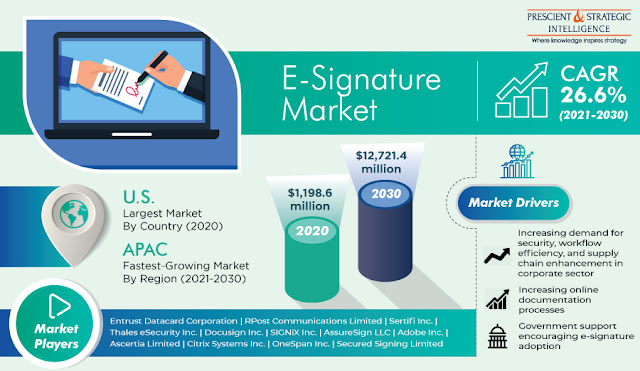
How Is Corporate Sector Boosting E-Signature Market Growth?

Image
Currently, the increasing adoption of signature pads for forensic information preservation is becoming a prominent trend in the e-signature market. Signature pads can safeguard the forensic information of signatures, such as writing dynamics and pressure, owing to which they provide an extensive degree of security and personalization. This device uses a pen-type stylus to capture a handwritten signature. It has gained high prominence in the banking, financial services, and insurance (BFSI), government, and healthcare sectors. For instance, financial institutions of the U.S. are using pen interfaces for transforming the banking experience. The component segment of the e-signature market is classified into service, software, and hardware.  Among these, the software category dominated the market in 2020, and it is also expected to retain its dominance in the forecast years. This can be owed to the surging use of advanced and cloud-based e-signature solutions with encryption through p...

How Is Gamification Technology Helping Businesses Monitor Employee Progress?

Image
Currently, these software firms are integrating artificial intelligence (AI) and machine learning (ML) to study the success rate of gamification solutions with a dashboard. Businesses are extracting insights into customer behavior from gaming platforms and analyzing them through business intelligence (BI) tools. For example, in September 2018, Tritium Software S.L. (ForceManager) acquired Sellf S.r.l., a Europe-based customer relationship management company providing gamification solutions, to integrate its AI capabilities into the field sales gamification solutions of the latter. Apart from technological advancements, these and other software vendors that offer gamification solutions have engaged in mergers and acquisitions to improve their product portfolio. For instance, in September 2017, SAP SE acquired Gigya Inc., a customer identity and access management software company, for $350 million. With this acquisition, SAP SE integrated Gigya‘s identity and access management platform i...

High Demand for Semantic Search Platforms Driving Natural Language Processing Solution Demand

Image
Natural Language Processing (NLP) allows machines to improve human-machine interaction by offering filtered information after decoding human inputs and studying unstructured data. The filtered information obtained by using NLP solutions is more appropriate and specific. In contemporary times, Siri, Alexa, and Cortana are some of the widely used technological solutions, where the NLP technology is used to improve the semantic search experience.  Thus, the increasing use of such semantic search platforms will boost the adoption of NLP services and applications in the foreseeable future. Additionally, the increasing focus of end-use industries on the adoption of automated solutions is also expected to propel the natural language processing market at a robust CAGR of 19.7% during the forecast period (2019–2024). According to P&S Intelligence, the market was valued at $8.3 billion in 2018, and it will generate $22.9 billion revenue by 2024.  Automated solutions assist business...

Certificate Authority Market to Generate $285.7 Million Revenue by 2030

Image
The certificate authority market is expected to demonstrate a CAGR of 12.3% during the forecast period (2020–2030), owing to the escalating need of businesses to establish trust among online customers and rising public awareness about secure web access.  Additionally, the booming population of internet users and increasing number of transactions that require authentication and secure connection will also help the market revenue surge from $81.7 million in 2019 to $285.7 million by 2030. As per the International Telecommunication Union (ITU), over 51% of the global population were internet users in 2019. In recent years, there has been an exponential surge in the number of online customers, owing to which, businesses have been focusing on establishing trust with their existing and potential customers. The increasing need to build trust is an outcome of the availability of a wide horizon of products and services online.  In such an intense competitive ecosystem, brand trust and ...